
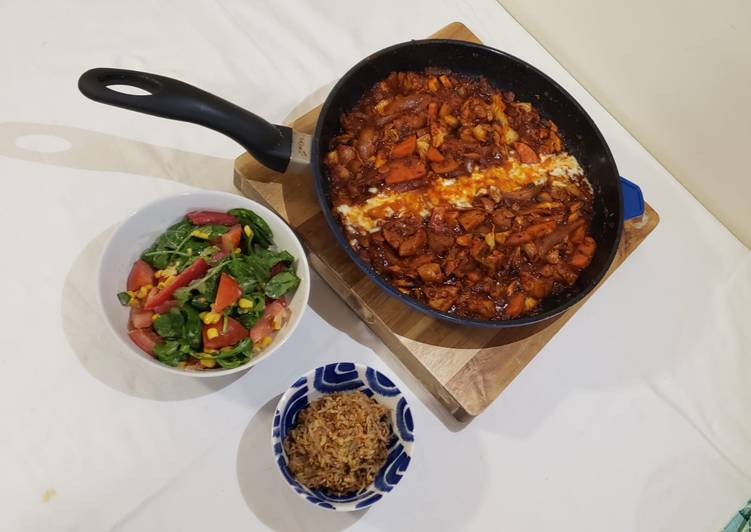
Hello everybody, it is me again, Dan, welcome to my recipe page. Today, I’m gonna show you how to make a distinctive dish, dakgalbi (korean spicy chicken). It is one of my favorites. For mine, I am going to make it a little bit unique. This will be really delicious.
Dak galbi or dakgalbi (닭갈비, Korean spicy chicken stir fry) is by far my all time favorite Korean dish. And, I absolutely loved having it every time! Cabbage, carrot, chicken, chicken drumsticks, chicken thighs, corn syrup, garlic, ginger, green chili pepper, ground black pepper, honey, hot pepper flakes, kimchi, milk, onion, perilla leaves, rice, rice cake, rice syrup, sliced rice cake, soy sauce, sugar, sweet potato, water.
Dakgalbi (Korean spicy chicken) is one of the most popular of current trending foods on earth. It’s easy, it’s quick, it tastes delicious. It’s appreciated by millions daily. They are fine and they look fantastic. Dakgalbi (Korean spicy chicken) is something which I’ve loved my whole life.
To get started with this recipe, we have to first prepare a few ingredients. You can have dakgalbi (korean spicy chicken) using 19 ingredients and 6 steps. Here is how you cook it.
The ingredients needed to make Dakgalbi (Korean spicy chicken):
- Prepare Marinate Sauce for chicken
- Prepare chicken tight fillet
- Make ready gochugaru (Korean red hot pepper flakes)
- Make ready Gochujang (Korean red chili paste)
- Prepare soy sauce
- Make ready garlic cloves (minced)
- Get minced ginger
- Make ready mirin
- Get maple syrup
- Take sesame oil
- Get Black pepper (to your liking)
- Get Vegetables and extras
- Get cabbages
- Make ready sweet potatoes
- Take sliced mushrooms
- Make ready medium size onion
- Prepare spring onion
- Make ready Mozzarella cheese (optional)
- Prepare cooking oil
Featuring succulent pieces of Korean spicy chicken stir fried in a mouthwatering Dakgalbi sauce and smothered with melted cheese. Bring the biggest flavours of Korea to your kitchen table. This is a spicy Korean stir-fried chicken dish. If you have any question about the ingredients, please ask me.
Instructions to make Dakgalbi (Korean spicy chicken):
- Cut chicken into small bite pieces and put it in a bowl with all marinate ingredients. You cannot substitute the hot pepper flakes and hot pepper paste with other thing (it has to be the Korean version), or it will change the flavour completely.
- Mix everything together until all combined. Wear gloves or use spoon/fork to mix it, as it's hot! Set aside and marinate for at least 30mins (longer is better).
- Prepared the mixed veggies while waiting for chicken to be marinated. Chopped veggies to smaller sizes/chunks.
- Heat up the cooking oil on a wide narrow pan (if you have) skillet/paela pan should work (medium heat). Placed chopped veggies on the pan, top it with the marinated chicken and the rest of the marinate sauce, let it cook for 3-4 mins without stirring it.
- Slowly stir the chicken with the rest of the veggies, so the sauce will be well distributed on the pan. Do not stir the pan too often, only stir occasionally.
- Optional: once everything are cooked and sauce is thicken, make space in the middle of your pan and placed the mozzarella cheese and top it with sesame seeds. Served with rice and other Korean side dish (kimchi, bean sprouts etc).
Dakgalbi is a popular food in Korean restaurants. Just the dakgalbi alone is very delicious, but you haven't lived until you try this stir-fried rice style. Dak galbi is the South Korean variety of stir-fried chicken. It is a communal dish that's cooked tableside, on large cast iron skillets. Typical elements in dak galbi include various chicken cuts, cabbage, tteok rice cakes, carrots, chili peppers, and sweet potatoes.
So that is going to wrap this up for this special food dakgalbi (korean spicy chicken) recipe. Thank you very much for your time. I am confident that you can make this at home. There’s gonna be more interesting food at home recipes coming up. Remember to save this page on your browser, and share it to your family, colleague and friends. Thanks again for reading. Go on get cooking!